8 Ways Commercial Real Estate Brokers Win More Business With Better Client Deliverables
Clients judge a brokerage team on what lands in their inbox: how fast the presentation arrives, how clearly it tells the story, and how well the pitch holds up.
Commercial real estate brokers win more business by giving clients a faster, clearer way to make a decision. Market knowledge gets a broker in the room, while the market survey, comp set, or broker opinion of value (BOV) is what the client judges after the meeting, often against similar documents from two competing firms.
On most brokerage teams, the lead broker owns the relationship, while the support team, usually client services coordinators (CSCs) or analysts, builds the deliverables. How well that process runs shapes how fast the team responds and how the client sees the firm.
Today, this comparison is getting harder to pass with a static file. More than half of tenant-rep brokers name static PDFs as their top client-experience failure, and their teams spend about 40% of their time building deliverables.
One regional firm nearly lost a client to a national competitor because its manual process couldn't keep up. The firm changed how it delivered its work and kept the account. The client preferred the new experience to what the competitor had shown them.
These eight deliverables are where that difference shows up:
| Deliverable | The client decides | The broker wins |
|---|---|---|
| Market survey | Which spaces best fit their needs | The first tour |
| Employee commute analysis | Who a move helps and who it hurts | Sign-off across the executive team |
| Demographic analysis | Whether a location works for the people it needs to reach | A stronger site recommendation |
| Comps database | Whether a rate is fair | More leverage in the negotiation |
| Development pipeline | What is available now and what is coming to market later | Proven credibility as the market expert |
| Competitor mapping | How a location fits the business | A sharper pitch |
| Broker opinion of value | Whether a property is worth that number | More assignments |
| Branded listing site | Whether a space is reaching active requirements | Smarter insights to bring to ownership |

1. Send an interactive market survey first to win the tour
A commercial real estate market survey shows a tenant the available spaces, rates, terms, and locations that fit its requirements. The broker who answers first with a clear survey usually gets the tour.
Picture an office or industrial requirement landing late in the day, with two other firms working the same request. The lead broker is with the client, so the CSC or analyst spends the afternoon pulling numbers from raw data reports, rebuilding the same layout in a design tool, and sending another survey_v4_FINAL.pdf. Then the client's feedback scatters across email threads.
What a strong tenant-rep market survey includes:
- A short list built around the requirement, not a 100-page market dump
- Every option plotted automatically on an interactive map
- One live link that stays current when a rate or availability changes
- Fast updates as rates and client priorities shift. ScoutAI lets teams type a request like “Update the rates on all units at 108 Central to $23/SF,” then initiates the changes in seconds [CONFIRM: beta status and speed claim]
- A way for the client to favorite and comment on spaces directly in the survey, so the broker knows what is landing before the first tour
“ScoutSpace helped me quickly put together a market survey and tour schedule, allowing us to respond promptly and helping ensure that we were the firm they chose to work with.”
Joe DeBarr
Associate, Lee & Associates
ScoutSpace market surveys start from a CSV or an existing PDF, fill in the property details, and plot every space inside a client-branded link. Most brokerage teams go from requirement to shareable survey in under 30 minutes.
2. Use employee commute analysis to get the whole leadership team to yes
Employee commute analysis measures the drive from each employee's home to each property under consideration. It gives an executive team a number to weigh when an office or industrial relocation could cost them people.
A venture-backed freight technology company in Dallas needed to grow from 8,000 to 43,000 square feet. For its Head of HR, one question mattered above almost all others: what the new commute would mean for the team. “We were very mindful not to overly burden employees with the office relocation,” she said.
Her broker ruled buildings in or out on commute before the first tour, so the CFO, COO, and Head of HR arrived with targeted questions instead of first impressions.
What a useful commute analysis shows:
- Real driving times, with or without traffic, rather than straight-line distance
- The share of the team within 15, 30, 45, and 60 minutes of each option
- How each option compares with the current office location
- Which employees a move affects most
ScoutSpace drive-time analysis uses the Google Directions API to calculate this for every employee and every property, down to the individual.
3. Add demographic analysis to make the site recommendation stronger
Demographic analysis adds population and market context to a site decision. It helps office and industrial teams show how a location fits the client's workforce, and retail brokers rely on it to show who lives around a site.
In ScoutSpace, Esri demographic data sits alongside commute analysis, so a team can turn on a layer without waiting a week on a specialized mapping team. [CONFIRM: one-week turnaround]
4. Build a comps database so the proof is ready when the negotiation starts
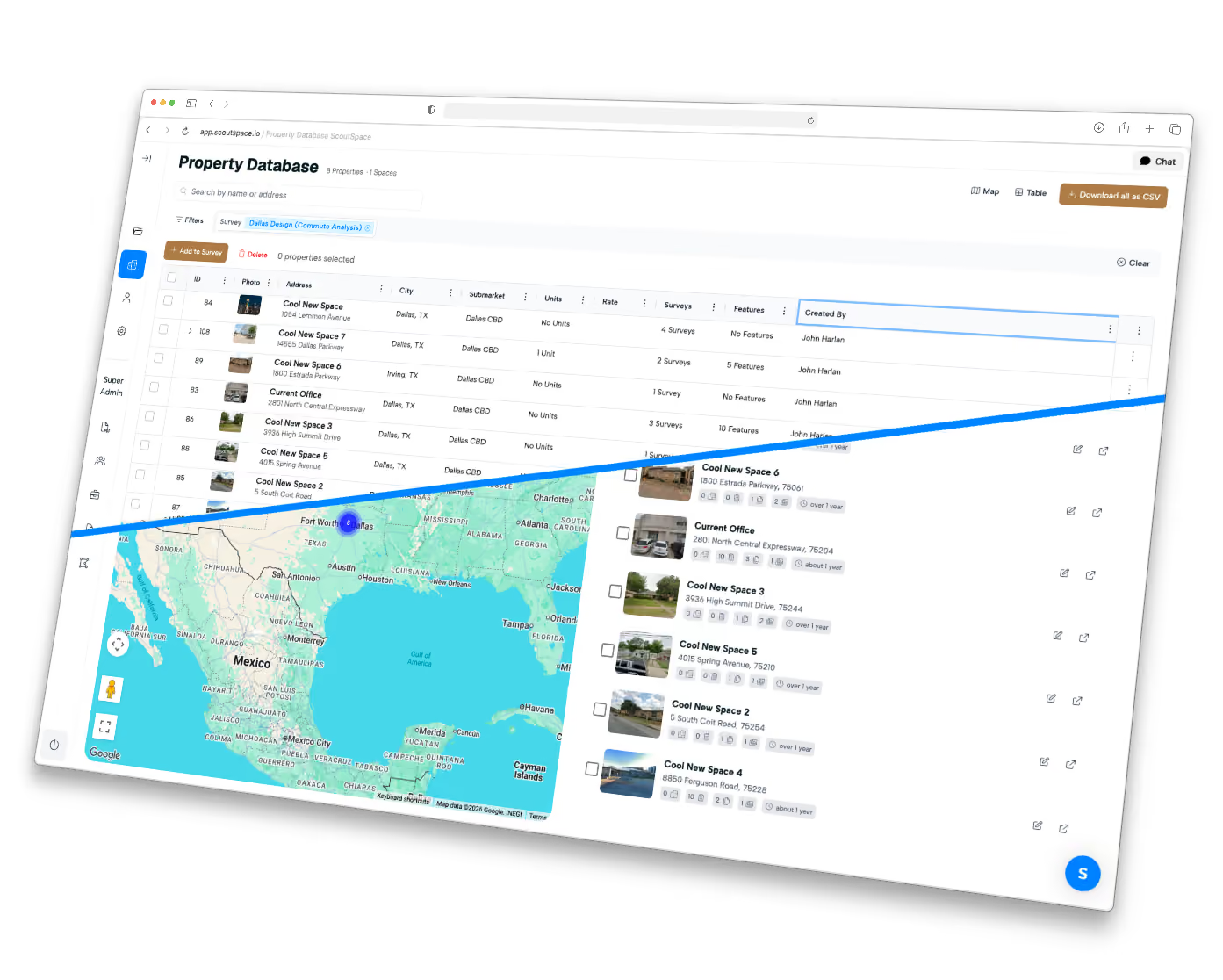
A comps database is a searchable record of a team's rent comps, sale comps, and availability data. It gives the whole team the evidence to back up a number instantly.
Across the table, a client quotes a rate you know you've beaten. Before ScoutSpace, the comp that proved it sat in a spreadsheet, an old email thread, or a colleague's memory. As one broker told us, “If my information is better than yours, I win.”
What makes a comps database worth maintaining:
- One shared source of truth, not one spreadsheet per broker
- Dates on every record, so the team knows how current a comp is
- Search and filter to find a comp in seconds
- Reuse in surveys, comp sets, and BOVs, so no one retypes the same data
Every deal then adds to an asset the whole team can use, and the support team stops reentering the same comp data.
“Using ScoutSpace, I can quickly share comparable properties and current market pricing in one place, giving them confidence that they understand their options and the market.”
Lindsey Shelley
Associate, LanCarte Commercial Real Estate
The ScoutSpace comps database ingests comps in bulk, flags duplicates to merge, and tracks rates over time on each property.
5. Track development pipelines to show clients what's coming to market
A development pipeline tracks projects from planned to delivered in any given market. Clients signing a long-term commitment want to understand what is coming, in addition to what is already available today.
This used to be a static map built by hand in design tools. In ScoutSpace, teams can track a pipeline for any property type in any market, then share it digitally in minutes.
6. Map competitors and amenities to show you understand the business
Competitor mapping places a client's competitors and surrounding amenities on the same map as the properties under review in the market survey. It shifts the conversation from the building to how the location serves the client's business.
Office teams map a tenant's competitors and nearby amenities, industrial brokers map notable neighboring tenants, and retail brokers map big-box competitors, all in seconds instead of by hand.
7. Show the reasoning behind a BOV to win the assignment
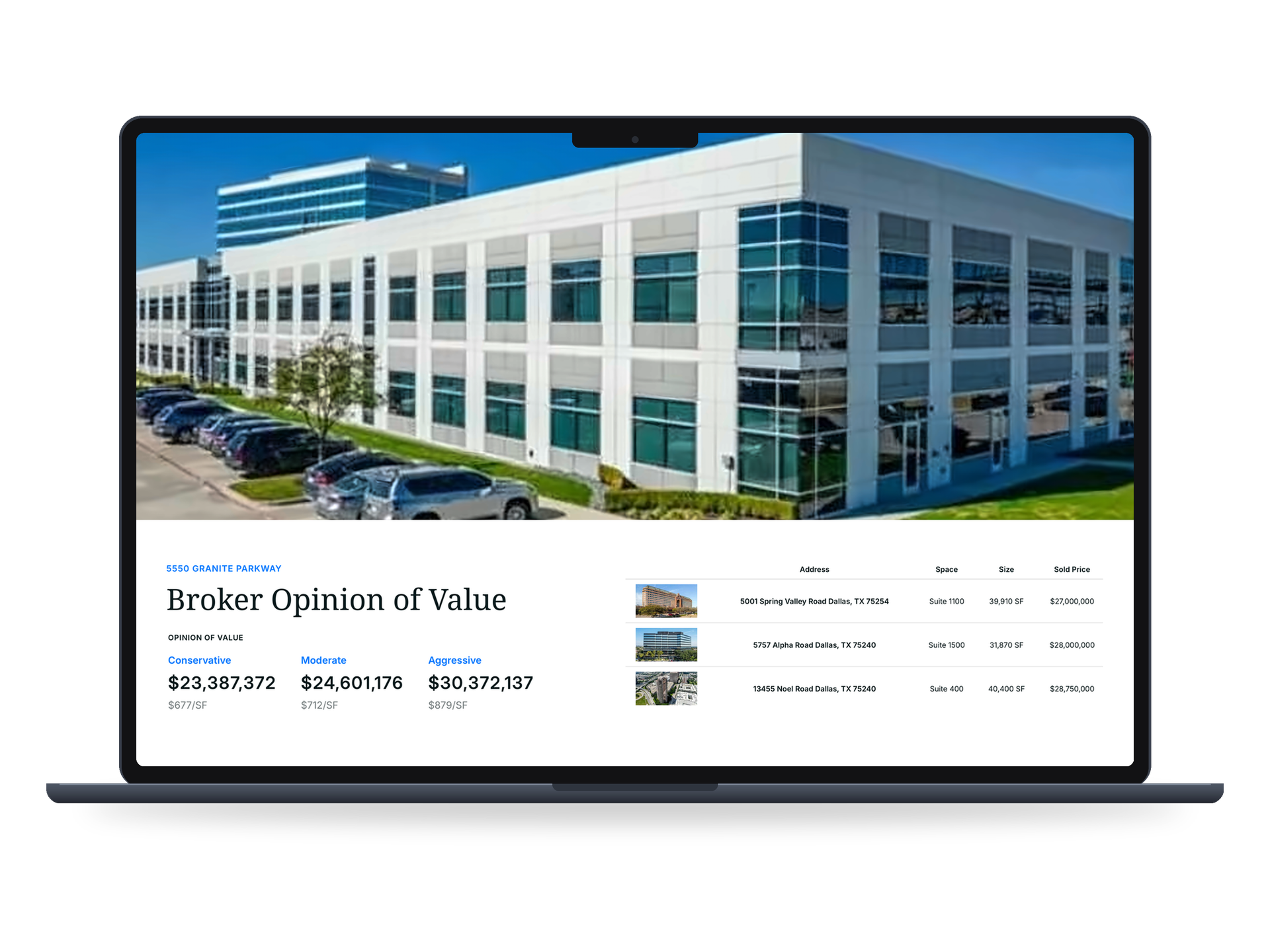
A broker opinion of value (BOV) is a broker's estimate of what a property is worth, based on comps, nearby listings, financials, and more. For teams that also represent property owners, it often decides who takes a property to market, so the reasoning carries as much weight as the number.
Most BOVs are still stitched together in a spreadsheet and sent as a long PDF. The owner sees the value, but the judgment behind it gets lost in the fine print.
What a persuasive BOV includes:
- A clearly marked subject property
- Lease or sold comps, active listings, and financials in one view
- A note on every comp explaining why it's in the set and how it affects the value
- An interactive format the owner can explore, with a PDF available as a leave-behind
That level of clarity can decide the pitch. Trey Dove, Senior Vice President at Partners Real Estate, says of his ScoutSpace BOV: “It won me one of my best new clients I've signed in years.”
ScoutSpace BOVs bring that evidence into one live link, with the broker's rationale next to every comp.
8. List space where tenant-rep brokers are already building their market surveys
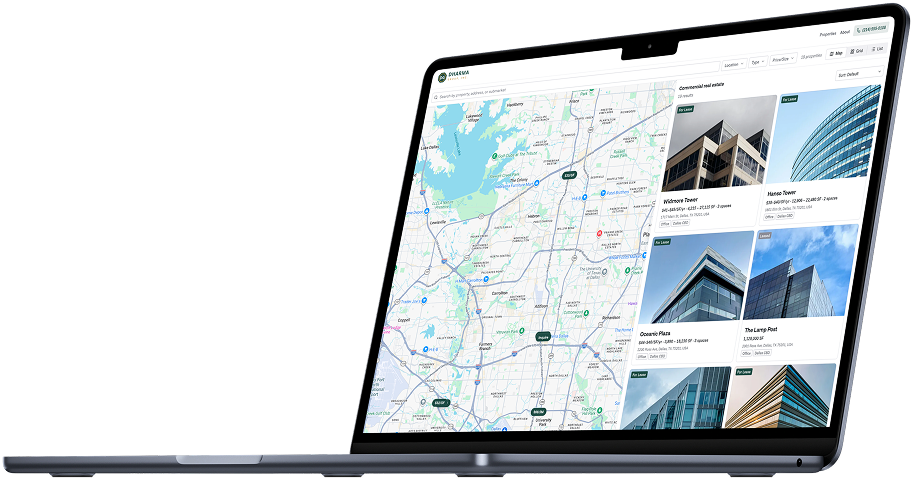
A listing site puts available space in front of the market. Listing space is the core of a landlord-rep broker's business. For tenant-rep teams, this comes up most when a client is looking to sublease their space. In both cases, the client wants their space seen by tenants who are actively looking, and wants proof that their listings are working.
What a strong listing setup includes:
- Visibility with tenant-rep brokers working on active requirements, so the space is seen while shortlists are being built
- An alert when the space lands on a survey, so the team knows it's in play (coming soon)
- Activity from real tenant-rep brokers, so client updates come with real intent instead of vague page views
- Inquiries that go straight to the lead broker, so a fast response sets the pace for a tour
- A branded site with control over what goes public, down to rates and terms, so each listing represents the firm and the client
Most public listing sites can only show who viewed a page. Listings by ScoutSpace puts the space on your firm's branded site and in front of the tenant-rep brokers building surveys in ScoutSpace. You get an email when one of them adds it to a survey [CONFIRM: matches the alert's coming-soon status], and activity sheets give you a clear answer when your client asks how the space is doing.
What these eight deliverables have in common
Each one is a moment when the client quietly grades the brokerage team. A survey they can explore, a pipeline that shows what's coming, a rate backed by history, a value with its reasoning attached, and a listing report built on real intent all send the same message: this team has done the thinking for me.
The brokers pulling ahead and winning more aren't working more hours. They're giving the other side of the table a better experience, and letting that first impression move the deal forward faster.
The next requirement, the next listing, and the next negotiation are already on their way. ScoutSpace keeps you ready for all of it.
Better property presentations are just a click away
See how ScoutSpace can improve your workflow with a live 30-min product demonstration.


Survey, tour, and now market your buildings — all from one place.